The Numbers

Just how bad is it? What proof do we have that humans are changing the earth system?More importantly, what are the predicted effects of climate change?

The attached file is a report on climate change (and its anticipated effects) in the United States, but it has been written with the goal of communicating information to the general public. In other words, while it is a highly researched report that contains large amounts of valuable information, it has been somewhat “dumbed-down” and made less science-y, in order to make it more easily read and understood by the common person. It is quite long (just about 200 pages), but you can either skim it or use the table of contents to navigate your way to the issues and areas of climate change that specifically are of interest to you.

I found it to be a very good source of information regarding climate change and its effects in many different sectors and in the different regions of the United States.

File: Karl 2009 climate-impacts

Shit Hitting the Fan

The following post is an extended analogy of both our current situation and life, as we continue into the Anthropocene with or without changes in our ways. (Forgive me God, Mom, and all non-foul-mouthed individuals of Earth, but the analogy was almost a perfect fit for our situation. I take this moment to formally apologize ahead of time for any disturbing visuals and/or vulgar vocabulary. If you cannot handle either of these things, discontinue yourself from reading any further.)

It’s already happening, and the mess is already being created. Shit is hitting the fan. It has been for quite some time, actually. In terms of the Anthropocene, this means that the effects of this new geologic epoch, and, more importantly, the effects of the continued practice of our detrimental ways, have begun to surface in greater and greater multitudes. While some effects are surfacing and others have already surfaced, there is still much that we do not know. So, in relation to my analogy, shit is hitting the fan, but we don’t know how much shit is going to continue to hit the fan. What does this mean? Well, quite plainly it means that nobody knows just how big of a mess there is going to be, just that one is in the process of forming.

It’s actually just as appalling to think about the Anthropocene and its effects as it is for me to think about feces being scattered by a fan. It’s disgusting that the most dominant, successful, intelligent species on this precious planet would be so careless, absorbed in themselves, so intoxicated with the prospect of “more” that we disregard the very Earth on which we live. Nauseating, isn’t it? Exhibit A: Instead of looking to renewables, we frack, creating unhealthy “side-effects” not only for the environment, but for ourselves as we attempt to squeeze even more harmful resources out of the earth. Exhibit B: Our actions have increased the intensity of tropical storms, leaving cities leveled and many people homeless or dead under the wreckage. Exhibit C: The continued injection of Carbon Dioxide into our atmosphere has acidified the oceans, bleaching coral reefs, one of the most beautiful ecosystems on the planet. Exhibit D: Through our exponentially growing exploitation of nature, more and more species are becoming endangered and facing extinctions. When will enough “shit” accumulate that we wake up?

So what will happen as the shit continues to be poured into the fan? I don’t know specifically, though I know that the conditions will not be pleasant, to say the least. I mean, picture your home, the home you grew up in, the places you spent your childhood. Now picture those same places, with thousands of tons of shit (literally) blown all over them. This is a (very good, I believe) metaphorical depiction of the world we are creating for our future if we continue with our current trajectory. It’s time we changed, time we stopped, time we turned the fan off and quit throwing our shit at it–while we still have the option to do so. It may seem like a vulgar (ok, it is definitely vulgar) and elementary analogy to use, but in reality, as we continue our current ways and practices, we are in essence “throwing more and more shit at the fan.”  Our problems will only grow exponentially, expeditiously creating a larger and larger and more and more complicated mess than the one we currently face. Quite a disturbing visual, right? Well, that is the disturbing reality of the now.

It is time for Earth’s dominant species to take heed to the situation we have conceived. As the name implies, the Anthropocene is our fault, not so much through our specific individual deeds, but through our society-wide ways of life: our belief in our own infallibility. That, to me, is the most terrifying part of the entire situation, that society has not yet waken up from their trance, although we see the shit splattering. We are so caught up in our own ways, that although we are beginning to understand and discover the implications of the Anthropocene, we sit stagnant. We know that what we are doing is wrong, yet our definition of progress and our longing for “more,” fueled by the developments of our civilization through time, trumps this knowledge. We ignore it. We are made blind to our wrongness through determined and defiant ignorance, because admitting we are wrong would be so in conflict with those underlying ideals that have been so set, so deeply carved into our culture. We see the mess, but nevertheless, we continue to throw shit into the fan, rather than attempt to shut the fan off and fix our state of shitification (not a real word, but I believes it applies here).

If we continue this shit throwing, how long will it be until we no longer have the option of unplugging the fan? How long until the hope of ever being able to clean our mess dissolves? I don’t know, but I know that there will be a time where we will be forced to change, where living as we currently are will not be an option, where we are buried in our “shit” mess and have no alternative but to adapt. I hope we never reach that point, because when we do, I believe all good and order in the world as we know it will collapse. Right now, we have a choice, and I don’t understand why we continue to let the shit hit the fan. I don’t understand why we insist on living with this mess we created. We cannot begin cleaning the mess until we stop creating it. This is the first step on the path to change. We need to act proactively while we still have the power to do so, because when we reach the point where we can only act reactively, we will be vulnerable, unprepared, and at the mercy of whatever comes next. It’s time we change our ways; to change everything; its time for our shit to stop hitting the fan, for the sake of our futures.

References: This Changes Everything, Klein; “Gasland” documentary; “Disruption


The Other 3%

I had a dilemma this week…what to write about?  I really had no clue what I was going to write in this blog until one of my classes on Thursday that made me so mad, that for the first time in my college life, I wanted to get up and walk out on their lecture.

I had a professor (I won’t mention their name) say something about the some presidential candidates and how they don’t know science.  I was assuming they were talking about Trump or Cruz, but they were talking about Clinton and Sanders.  The basic claim was that they don’t know science and that the burning of fossil fuels is not what is causing global warming and that it is just doing its natural process.  “We need to prepare for global warming, but not burning fossil fuels won’t help any.”  This is a professor that teaches a “Natural Science” subject!

They went off on a rant and basically called the “Liberal” idea of human caused climate change idiotic, stupid, and not based on real science.  The common estimate is that 97% of the science community believes humans are causing the change in climate…I just found one of the other 3%.

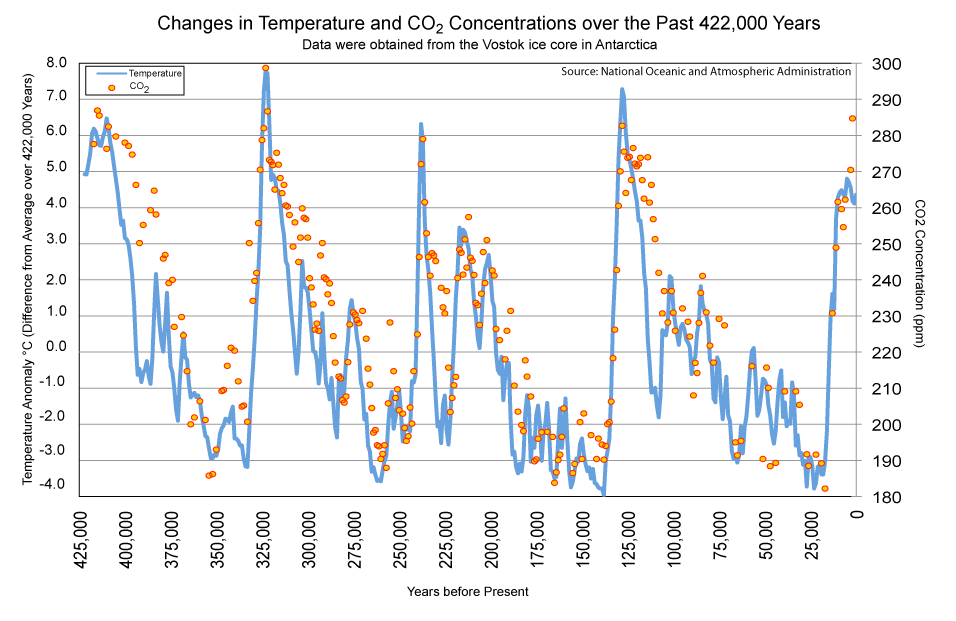
Their idea that the warming is caused by natural climate processes comes from ice cores from Vostok Station in East Antarctica.  Problem one is that that is only one source.  To be accurate for a global temperature you need to have other sources, such as ice cores from Greenland, upper altitude glaciers, lake sediments, from other sources than just Antarctica.  Ice core from one location does not always tell the total global picture.

Vostok_TemperatureCO21

http://sites.gsu.edu/geog1112/files/2013/03/Vostok_TemperatureCO21.png

Here is an example of the graph they handed out.  Their claim was that it took a long time to cool and that it warmed up quickly.  So, when Clinton or Sanders said that we have to worry about how fast we are warming, they said it was nonsense.  “Look how fast it warms up in this chart!” is what they said.  Yep pretty fast…even though after the last glaciated period it took almost 25,000 years to rise to the pre-industrial time period.  I know that is fast in Geologic Time, but we have only been involved in the Anthropocene for a few hundred years and we have already raised it by 1°C in that time.  By the chart is usually took thousands of years for 1°C.

In the graph it does show that CO₂ levels do lag the temperature which would be a positive feedback.  The warmer it gets the more thawing and releasing of CO₂ into the atmosphere which causes more warming.  But, this is only on location on earth.

Other researcher, such as those by Jeremy Shakun (Harvard postdoctoral fellow), claims that this is not the case globally and that many locations show the opposite effect.  It is said of his research that “It’s the most comprehensive analysis ever done of carbon dioxide and temperature at the end of the last ice age, and it shows quite clearly that in most of the world, the thermometer began to shoot up only after the atmosphere was spiked with carbon dioxide.”

http://thinkprogress.org/climate/2012/04/09/458724/deniers-global-warming-preceded-by-increasing-co2-levels-last-deglaciation/

What brought all this about is the material we have been reading and the documentaries we have watched this week in class.  We read an article from Timothy Mitchell called Carbon Democracy.  We watched the Colorado Experience: Ludlow Massacre and Oil Spills in Nigeria.  What all three of these have in common is the politics and capitalism that go with coal and oil and how people are affected by these resources.

Carbon Democracy was and eye opener to me because of the way the “West,” especially the U.S., has had their hand in controlling the Middle East oil production for almost a century.  I have known of the U.S. influence and ideologies concerning oil production and the Middle East (I served in Operation Iraqi Freedom, but I had no clue to the extent and for how long the U.S. has been involved in it.  It is actually quite disturbing.

How does the material from this week and the professor’s comment all tie together you ask?  They are in the Geology Dept (all I will reveal here) and most of their research is in hydrocarbons and oil source research.  Basically they look for future crude oil to be pulled out of the earth to be burned and put into the atmosphere.   That is why they don’t mind the burning of fossil fuels.  If there is a fix that is needed to change the climate it needs to be at the end of the equation, but not the beginning.

Their comment in class made me think to myself…”this person sounds like an oil & gas lobbyist!”  Sadly it turns out I was right.  Hopefully the others in the class can see through his political agenda like I can.  My biggest concern is that some students in the class won’t take any more natural science classes in college and their opinion has been shaped by this professor.

Power and Influence

I think most of us can come to the general agreement that in most of the modernized world (or at least in the United States), the care of/concern for the economy reigns superior over the care of/concern for the environment. Or, simply put:

  • Economy > Environment

However, this way of thinking and hierarchy of importance can be changed through an influence of one power or another. Below are a list of inequalities that compare different amounts of influence. Through the inequalities, you can see that not only are the issues of our society categorized in a hierarchical fashion, but the influence of different powers within our society is hierarchical as well.

Influence:

  • Those With Power > Those Without (The People)
  • The Voices of the Powerful > The Voices of the People
  • The Voice of the People > The Voices of the Powerful


“We the people . . . ”  –Constitution of the United State of America

The hierarchy of voices is the key to change. In the past, all large-scale revolutions have not been a deranged screech of many voices, but have held the focus of one voice. One loud, echoing, assaulting, unified chorus of a voice. In chapter nine of Naomi Klein’s work This Changes Everything, she discusses blockadia. Throughout the chapter, she provides illustrations of numerous movements and coalitions–unified groups of individuals–that are combatting climate change and our dependency on fossil fuels. The many examples that Klein describes show the power of a unified people. Additionally, in the video “Colorado Experience: Ludlow Massacre” it can be seen in an underlying message of the video how (despite the violence) the unification and determined focus of a group of individuals could spur change that’s effects are still observed today. Lastly, we can look at the colonists of the American Revolution. These individuals felt dissent for the British Crown for some time, it is no secret that the many individual colonists were quite disgruntled. However, it took their unification, their collective action, their one voice to bring the sparks of the revolution together in order to give birth to the searing change. All the groups and organizations listed that reached success, did so because of their unification. They took the individual voices of the many, joined them together, and gave them a focused direction to work towards–they funneled the voices of the many into a single penetrating, highly effective voice. This was what gave them their successes; they gained the power of influence, and that allowed them to have a say, ultimately leading to (some) change.

Take the discord of the many and form it into a harmonious, urging plea for the change we need. Make not a jumbled “we” of “I”s, but create an “I” out of the “we.” One voice that holds the shouts of many. This “I” formed out of the many individual “I”s of the “we” will be a true, whole, and united “We.” A “We,” driven by a single, unanimous focus, like an “I,” yet containing all the energy and power of the many of the “we.” This is where the real power of influence lies: in the people, united. We the people hold more meaning than any other power that seeks influence, and the way I see it, our time to exercise that influence has been long over due.


Update on Visitors + The Role of the Individual

So, somewhat recently, I mentioned in a post about how I put the link to my blog out on Facebook and Twitter, and also sent it to numerous individuals in my email contacts. This post is an update that wishes to highlight the results of these actions, but also will discuss several other greater points related to “getting the word out.”

Untitled

This graph shows the total number visitors each day from the start of the blog to present. Especially note the peaks of March 4 and 19, as these are the days where I shared a link to the blog with my Facebook friends. The peaks on Marcy 7 and 8 are days where my mother and another family friend shared the post with their friends. This illustrates the role social media can play in spreading awareness and information about the Anthropocene. I foresee social media playing a major role in the initialization of any mass movements regarding climate change, as its value of connectivity is unparalleled and the diverse amounts of people it can link is truly massive. Social media can link people that would never be connected otherwise, and networks of connections like this will be essential as diversities of peoples across the globe come together.

Additionally, I know that 35 (the highest number of viewers the blog has had on any given day) is not necessarily a number carrying much bragging rights, especially when there is 10-15 students in my Environmental Anthropology class (which the blog is an assignment for), which means that the number of true “outside viewers” was only around twenty. However, I see that as progress. While the pure statistics may not hold much weight, the possibility of conversation, awareness, emotion, impulse, and interest sparked within those who viewed the blog is highly variable and valuable. Simply getting the word out, with an aim of encouraging concern, with the hope of creating a movement, can eventually begin to show results.

In class, as well as in some of the readings, a grassroots movement/revolution has been discussed as the catalyst by which the change necessary to sustain ourselves in the Anthropocene will be produced. Our blogs are, in a way, acting as miniature catalysts to aid in the formation of that even larger catalyst. This is where I find my serenity as I struggle to come up with ways in which I, as an individual, can take meaningful action. I know that I am at least putting some fuel into the fire, though it may be minimal. This is the role the individual can play: the role of the initiator. Individuals can initiate unification, and after unification, the unified group can grow and ad an exponential amount of fuel to the fire, and this is where the people can begin to conceive societal change. The change happens because of the “we,” but maybe it will take the leadership and trailblazing of multiple “I”s to urge the creation of the greater “we” coalition.

Now That’s What I Call Anthropocene Music Vol. 1

I would be what people call a pessimist, so I do not have a very optimistic belief in humans combating climate change.  I believe that some of us will do, or try to do, everything we can to help in the uphill fight against climate change while others who seem to deny climate change make it worse.  They won’t change their beliefs or way of life until they have to.  Instead of being proactive against climate change I believe most will be reactive.  “I told you so!” is not something I look forward to telling people in the future.  Sometimes they are just listening to the wrong people.

Most of the songs on my list are about changing people to benefit the world.  Since it will take a global change from people from all different locations and societies I tried to include multiple genres of music to try and reach as many people as I could.  There is also a song that shows my own progression of beliefs on climate change and what is needed to be done by everyone.    Nobody does 100% of what they can to limit their affect on the climate, but a little change is better than none.

Burning for You – Blue Oyster Cult

Burn out the day
Burn out the night
I can’t see no reason to put up a fight
I’m living for giving the devil his due

And I’m burning, I’m burning, I’m burning for you
I’m burning, I’m burning, I’m burning for you

This song basically shows us one of the largest polluters of CO2.  Burning fossil fuels to create energy and transportation of people and goods is releasing a very large number of greenhouse gases into the atmosphere creating a rising global temperature.

Land of Confusion – Disturbed

There’s too many men, too many people
Making too many problems
And there’s not much love to go around
Can’t you see this is a land of confusion?

This is the world we live in
And these are the hands we’re given
Use them and let’s start trying
To make it a place worth living in

Climate change is one of our biggest threats mankind has ever seen.  But, our country has a huge division in the population and its politics about climate change.  Currently Democrats are more concerned with climate change than Republicans are.  There are those on both sides that do not agree with the majority.  Humans are creating the problem, and it’s time for use to start making our world better.

Hey You – Pink Floyd

Hey you ! don’t tell me there’s no hope at all
Together we stand, divided we fall.

This change will require a global effort on all levels because there is no simple and single fix for our problem.  We all must work together for the common good.  Both sides of the political scheme have different opinions, but we all should work together to meet our future needs for generations to come.

Invincible – Pat Benatar

This shattered dream you cannot justify.
We’re gonna scream until we’re satisfied.
What are we running for? We’ve got the right to be angry.
What are we running for when there’s nowhere we can run to anymore?
We can’t afford to be innocent
stand up and face the enemy.
It’s a do or die situation – we will be invincible.
And with the power of conviction there is no sacrifice.
It’s a do or die situation – we will be invincible.

Some people in the world are starting to get angry at the lack of action taken by governments around the world on this issue.   People around the world have the right to be angry because the actions of the few are destroying the world for the many.

It may be a do or die situation.  With the increasing temperature and rising sea levels people are going to be affected.  There is a possibility of mass food shortages and also a loss of habitable land for people to live on without overcrowding.

Change the World – Bone Thugs N’ Harmony

Everybody’s hating everybody, overrated
Why everybody acting agitated, I thought we graduated
Back in the saddle waiting, aboard the battle station
Hating is a birth defect and you know ain’t nobody perfect
And when the curtains, close open up the door, no more

See we loosing this world we love
And it looks like the sinning won’t end
So I’m reaching high up above
Lord, let your blessings begin

And let’s change the world, and let’s change the world

I adding this song to add to the diversity, but I also have listened to Bone Thugs N’ Harmony since high school.   Around the world the people who are less affluent are being affected by climate change at a much higher rate than the affluent population.  Climate change will affect everyone, but for some the affects are being felt more than others.  And, they are usually not the ones who are contributing the most to the problem.

This is causing hate and tension between social classes that is creating multiple issue groups come together to fight their cause, and at the same time fighting for a common enemy in climate change.

Don’t know what you got (Till it’s Gone) – Cinderella

Don’t know what you got till it’s gone
Don’t know what it is I did so wrong
Now I know what I got
It’s just this song
And it ain’t easy to get back
Takes so long

This song is such a cliché, but it is appropriate for the issue we have now.  For some we don’t realize what we have in this world until it is gone.  And, the vast majority of things we lose we will never get back.  Even if it can be replaced it won’t happen in our lifetime.

Now for a little more optimism songs to get people to think about change…

Don’t Stop Believin’ –Journey

Working hard to get my fill
Everybody wants a thrill
Payin’ anything to roll the dice
Just one more time
Some will win, some will lose
Some were born to sing the blues
Oh, the movie never ends
It goes on and on, and on, and on

Heal the World – Michael Jackson

There Are Ways
To Get There
If You Care Enough
For The Living
Make A Little Space
Make A Better Place…

Heal the World
Make It A Better Place
For You And For Me
And The Entire Human Race
There Are People Dying
If You Care Enough
For The Living
Make A Better Place
For You And For Me

Time for Change – Motley Crüe

I feel the the future
In the hands of our youth
No more lies
Old, tired fools tell our future
With tarot cards, and lie of crime The lines on their faces so deep, yeah
A revolution, or reach out
And touch the day
We’re overdue, child

Change
Now it’s time for change
Nothing stays the same
Now it’s time for change

And finally a song that I can relate to the most…hopefully others can too!

Better than I Used to Be – Sammy Kershaw

I’ve pinned a lot of demons to the ground
got a lot of old habits licked
but there’s still one or two I might need you to help me kick
standin’ in the rain so long has left me with a little rust
but put some faith in me
some day you’ll see there’s a diamond under all this dust

I ain’t no angel
but I’ve been sittin’ out a few more dances with the devil
and cleanin’ up my act little by little
I’m gettin’ there
I can finally stand the man in the mirror I see
I ain’t as good as I’m gonna get
but I’m better than I used to be

I collaborated with a group of seven people of family and friends.  We were playing the dice game Farkle and just casually talking about it.  I just told them which songs that I chose and the purpose behind them.  It was mostly me talking and discussing the Anthropocene and how each song translates to an issue that is currently going on and how people are affected.    Since I know more about the issues it was almost a lecture, but since it was with a game that may or may not have involved alcohol.

Family Feelings: Powerlessness

After creating my playlist (see previous post), I sat down with my mother Jan and brother Jorge (pronounced George) and after giving them an introduction to the Anthropocene (I did this by having them watch the “Disruption” film), had a discussion with them about climate change, the Anthropocene, and their effects. My mother is a middle-aged office manager for my dad’s insurance agency. She quite conservative, yet also cares about the well-being of her planet and has an interest in it (she reads a lot of National Geographic). My brother is a high school freshman who is more concerned with football and girls than the issues of the world. It is hard to tell whether he is left or right, because he is oblivious to politics. With these two family members, I hoped to gain further insight into the perception of the Anthropocene and its effects across varying age groups: One that is already set and busy with the life she lives, and the other soaking in his years of careless youth. How concerned can one be when they are already busy confronting the issues of everyday life, when global issues seem like just another problem in an already wronged world of busy chaos? Likewise, how concerned can one be when they have not yet been exposed to the world, when the future, adulthood, and global issues seem so far away from the right now? Within the discussion of the Anthropocene, I sought their thoughts, emotions, and opinions on the issue, and additionally, I asked them how they thought would be best to confront the Anthropocene in the oncoming years, to explore the solutions that are most apparent to other generations.

Right away, when I mentioned climate change and global warming, my brother blurted out, “I don’t like it being so hot.” He went on talking about how it made him sweat extra and all those kinds of things, but that’s not important. Attempting to push further, I asked him what he thought about the issue of climate change. Summarizing his statement: “Our future is screwed, so why care?” He made the point that we are going downhill as a society (though my guess is he got this opinion from his teachers, our parents, and other adults in his life), and this essentially led him to a YOLO (You Only Live Once) mindset. My mother said that the issue of climate change is scary to her, because she worries about the future of her children and grandchildren. She said there’s definitely the information to back up what the scientists are saying, and finds it ridiculous that society hasn’t done anything about it. Both also voiced concerns in relation to the uncertainty that comes with climate change. My brother wondered how hot this summer would be, and my mom had similar concerns, stating that this winter had already been “way too warm,” and that she wondered what this meant for the other coming seasons.

I then quizzed them on what emotions they felt in regards to climate change. My brother said he felt bad for those who are being affected, and that he wouldn’t want to be those people, but he said he also felt like there was very little he could do to help them. My mom said she was anxious about the future, but like my brother, she felt like there was little she could do to make a real difference. From this, I deduce that both feel at least somewhat worried about the oncoming effects of climate change and wish it would be stopped, but that they also do not put this worry at the forefront of their concerns, because they have a definite feeling of powerlessness when it comes to the issue. Working with this as my base, I went on to question them about what solutions they saw regarding climate change, and what they felt they could do.

Both my mom and my brother saw climate change and the Anthropocene as issues that need to be solved “top-down,” or, in other words, the government and big industries with the power must be the ones to initiate and implement the necessary changes. My brother said that he just sees the problem as “big,” bigger than him, which led him to feel a sense of powerlessness. He went on, and it became clear that a feeling of insignificance was prevalent within him. Jorge concluded by saying, “If the government decides it’s a big issue, everyone will decide it’s a big issue and do something about it.” My mother has similar thoughts, saying that she also feels a sense of helplessness. She asks: “What can we, the common people, the ‘average Joes,’ do about the problem?” Like my brother, my mom saw the solution as laying with the “power.” But, instead of looking to the government, she thinks that the oil industry must lead the change and stop burning the fossil fuels if they are harmful to our planet. It was interesting to see these opinions on how to go about solving climate change, and I believe that this is how the majority of people feel–powerless, insignificant, “what can we do, we are just normal people?”

However, when I voiced the idea that the “top” will not willingly change until it is too late, because they are making profits and society is continuing to “progress” with business-as-usual, they both agreed with me. I then put forward the idea of mass revolution and the unification of ordinary people joining together to stimulate the needed change, and they seemed to see this as a definite possibility. Putting that idea out there to them, that there is actually something to be said about “power in numbers,” cast the issue of climate change, and ways to go about fixing it, in a new light for them. The idea that the people actually have power gave them the small glimmer of hope that I currently hold onto, though I can only wonder whether or not that hope will manifest within them.

It was good to see that both my family members cared about climate change (and that they believed in it). Additionally, I found that it was interesting that both felt helpless in terms of solving the issue. To see two people so far apart in age voice such a very real sense of helplessness I think, illustrates the way many people (who believe in and care about it) feel about the climate change and the other effects of the Anthropocene. This is what I foresee as the largest hurdle to overcome when dealing with the issue–making the masses feel like they are not powerless.

Until the people can feel like they can make a difference, until we all see that we can be our own hope, I fear that the progress made can only be minimal. This is where emotion plays a role in solving climate change and making the necessary changes in the Anthropocene. When people’s emotions can shift from a state of powerless helplessness, they will be able to have some optimism, some sense of control of their future, and with that confidence, they will be better suited to take those necessary steps, and eventually the leaps, of change that are needed to sustain humanity in the future years of the Anthropocene. When we, as a whole, know that we are “already dead,” to quote Roy Scranton (Learning How to Die in the Anthropocene) we will overcome this hurdle, but not until we allow this notion to sink in. A mental and emotional shift is the predecessor to all eventual change, and in correlation with the thoughts of Mary Pipher (Pipher_GreenBoat): “Sometimes acting is the best way to cope” and “No one will save us but ourselves, so let’s get to work.” These ideas from Scranton and Pipher go hand in hand; when we accept that we are already dead, we can cope through action, and this is necessary, because we are our only saviors. It is time we made that shift–from a feeling of helplessness to one of capability; of weakness to strength. It is time we found our strength and unified under the banner of the people, only then will our actions truly make a difference; only then will our rally cries be heard on the distant ivory towers.

(My) Songs of the Anthropocene

I have titled my playlist “Playlist Anthropocene: Hope, Worry, and Our Future.” Based off the title, its simple to understand the emotions I most strongly feel regarding the Anthropocene–worry and hope, both for our future. I am very concerned about the current path we are treading in the world, yet I maintain a hope that we will soon realize that a better one can be found. In my playlist, you will see a definite reflection of this. The Anthropocene is a massive problem. Confronting it is unavoidable. What worries me is the effects that could fester if we do not proactively change our ways, but I hold onto my small shard of hope that we will make those necessary adjustments within our societies. This is the story that can be found “between the notes” of my playlist: one of worry, reasonably constrained by a glimmer of hope.

Playlist Anthropocene: Hope, Worry, and Our Future

Bleed Red – Ronnie Dunn: “Because my scars they are your scars, and your world is mine . . .” To me, this line, and many others throughout the song, speak about the unity and ‘whole’ of all of us as humans. The Anthropocene is not just going to affect us as individuals, but as an entire race.

7 Years – Lukas Graham: This song definitely speaks to life. It holds so much emotion for me as I continue to grow older and venture out into the world. What will the world look like when I’m 20? 30? 60? The idea of the future, and all its uncertainty, is terrifying. Where will our futures lead?

I Love This Life – LoCash: I love this life, I really do: The back roads, sunsets, bonfires, good friends, family, all of it. I’m sure many of you feel the same about the different ‘pieces’ of your life. How will the Anthropocene affect those ‘pieces’? “I love this life,” and the serenity it brings seems like it would very much diminish as more and more of the Anthropocene’s affects are felt.

Some Beach – Blake Shelton: All kinds crap happens the singer in the song, and he talks of “some beach, somewhere.” There is so many issues with our world and our society. I wish I could escape to a metaphorical ‘beach,’ but just like the singer, I can only imagine the beach, for now.

Something More – Sugarland: There’s got to be something more than this petty, grinding, struggling life. Our society reminds me of an anthill (if ants were more individualistic), a busy chaos of different people all going every which way, constantly struggling to make it and then to get ahead. There’s got to be more than a life within the system, more than the chaotic business.

She Used to Be Mine – Brooks and Dunn: We “did her so wrong, for so long.” We did our part to break the Earth. She used to be ours, now she is gone from us. This song can be seen as a metaphorical expression of how we are losing the beautiful planet that we have known for so long—it will never be the same. To simply think about that, should be enough to break anyone’s heart.

Every Rose Has Its Thorn – Poison: To me, this song can speak to the consequences of our ways of life. Yes, they were great and we have accomplished so much, but now we are beginning to find the ‘thorns.’ This is how I feel as well: nothing is without consequence, nothing is perfect, and everything will have pros and cons, just as “every rose has its thorn.” As we enter into the Anthropocene, it is important to remember this.

Carry on Wayward Son – Kansas: This song somewhat gives me assurance that things will be alright in the end; that things will work themselves out and it will all be okay. I worry a lot about the future, but I hold onto a small grain of hope that it will turn out. “I hear the voices when I’m dreaming, I can hear them say ‘carry on my wayward son, there’ll be peace when you are done, lay your weary head to rest, don’t you cry no more.’” This resonates with my hope speaking to me.

Clock Don’t Stop – Carrie Underwood: Time doesn’t stop, it doesn’t care. Time is here, it is infinite, and it is up to us to make the most of us. I’m afraid that regarding climate change and the Anthropocene, our clock is ever-nearing its striking hour. This makes me fret about time, and how it continues to pass as I, we sit and do seemingly so little.

Dancing in the Dark – Bruce Springsteen: This song is the one I go to when I need hope. “Can’t start a fire without a spark.” This ‘spark’ is the hope that is manifested in me and many others. I believe that this hope plays a major role in how we will deal with the Anthropocene, as it is this hope that provides what little light we have in what would be an otherwise dark picture, even if we are just “dancing in the dark.” My spark of hope is the only thing keeping me from giving in and giving up.

Habits (Stay High) – Tove Lo: With the darkness is foresee in our impending future, I sometimes allow these desolate and depressing thoughts to overwhelm me. Staying busy and looking for meaning in the world (my versions of ‘staying high’), along with my shards of hope, are how I deal with the stress of our dark future. Sometimes occupying the mind is the best way to keep it out of the depths.

BONUS TRACKS: DETRIMENT OF OUR OWN DOING (OIL OUR HELLACIOUS LOVER)


Wish You Could Have Turned My Head – The Oak Ridge Boys: Oil, or any other facet of our facet of our life can replace the girl in this song. Oil “shakes that thing” and we come callin’, again and again. I wish we could’ve turned our heads, because now we are hooked on it and can’t get enough.

You Shook Me All Night Long – AC/DC: First of all, think of the ‘you’ of “you shook me all night long” as oil, coal, natural gas, et cetera (basically, instead of talking about a girl, pretend the song is talking about oil). Secondly, take “shook me all night long” as being negative. Third, pretend that society is singing the song. Now, with all these metaphors put in place, listen to the song. It talks about how oil caught us and was so good, yet eventually, it shook us, meaning our society, to its foundations.

Walkaway Joe – Trisha Yearwood: Oil is our walkaway Joe. It seems like a great, wonderful resource for us to use at will. However, it is “destined to deceive us,” as, yes, it produces great amounts of power, but it also has massive negative effects. It truly is “the wrong kind of paradise.”

Trying to Love Two Women – Oak Ridge Boys: Trying to love two women: Oil and the Earth. You can’t do it, at least not successfully. “Sometimes the pleasure, ain’t worth the strain,” if there were ever lyrics that spoke more successfully to our society’s infatuation with oil, it would be these.

ADDITIONAL BONUS TRACK: FOR THE PAGE

Where the Blacktop Ends – Keith Urban: This song speaks to the title of the blog page (obviously), but the song can also be taken metaphorically to give us a deeper message regarding the Anthropocene. “Where the blacktop ends”; deviating from the norm; changing our ways from the path we have been treading upon for so long. Let’s “kick off our shoes and run with bare feet,” or in other words, just do it. Let’s “feed our souls” through reexamination of our definition of progress, and create new, better paths. But before we do any of that, we get off the ‘blacktop’ of our current situation.


Brownback’s Inferno Inspiration

So, several days ago, out of curiosity and inspiration spurred by reading about Mary Pipher’s coalition, I emailed our wonderful Kansas Governor, Sam Brownback. With all the cuts he has made to the education system, maybe he thought that students would never become informed enough to care about issues, and would, in turn, stay out of his hair. Sorry to inform you, but, Governor, your tactics have failed.

Ok, enough bashing the beloved leader of the state I call home (wouldn’t want to inspire more education cuts or anything, not that he would ever do such a thing).

Anyways, in the message, I asked him about energy subsidies in Kansas, whether he would say they were helping or hurting the fight against climate change, and if he would ever consider eliminating or lowering such subsidies.  Also, I asked him why he was not taking more initiative as we face the massive oncoming issue of climate change.

His response, is shown below.

Dear Mr. Hanschu:
Thank you for contacting my office and expressing your concerns about protecting our environment. I always enjoy hearing from my fellow Kansans and appreciate the opportunity to respond.
I have long stressed the importance of maintaining balance between the 3 E’s – the Economy, Energy, and the Environment.  My Roadmap for Kansas helps achieve this balance.  We will continue to encourage the expansion of an unparalleled economic development opportunity that will allow our state to regain its energy exporter status while also protecting the ecological jewels of our state.
The issues affecting agriculture, energy, and environment policy are of particular importance to Kansas. As one of the top 5 agriculture exporting states in the nation, the Kansas economy is directly connected to the agriculture industry. Kansas also has oil and gas reserves which make it an important part of our nation’s energy policy. The state has much to offer in the production of petroleum and bio fuels, as well as power production through solar, wind and nuclear facilities. Environmental integrity is also an important asset that Kansas enjoys. Clean air and water are a necessity – both for the public at large, and the agricultural production in the state.  Water quality concerns in the state have become increasingly important. I constantly look for ways to promote the mutual benefit of cleaner energy and a better environment – through agricultural production and innovation, as well as conservation techniques.
Once again, thank you for contacting my office.
Sincerely,
Sam Brownback
Governor of Kansas

“I have long stressed the importance of maintaining balance between the 3 E’s – the Economy, Energy, and the Environment.” Well, that certainly is a politician’s statement if I ever saw one. It’s as if he stresses that he is doing all he can to balance these three, when in reality, he predominately cares only about the first two. My reasoning for this interpretation: Trees can’t give money to your campaign and they won’t react against you when you hurt them.

Furthermore, he makes a statement about “protecting the ecological jewels of our state.” Please, are you really an idiot? I don’t care about protecting the Konza Prarie, or such-n-such nature reserve. I mean, yes, I do, but what I’m saying is that there’s more to our environment. Is not our entire planet one massive “ecological jewel” that we are letting go to hell? Sorry to break the news to you, but when the entire climate of Kansas goes under, our “ecological jewels” are going to go with it. So, why try to protect them as we destroy the land, air, and water around them?

Then there is this contradiction where he lists oil and gas reserves as a key element of Kansas’s energy policy, and then goes on to say that he looks to promote the “mutual benefit of cleaner energy and a better environment.” Hm. Please somone help me with this math. It’s as if he thinks of the best way to please the environmentalist and the oil company, which ends up catching him in a mess of his own words, though, I’m sure that if I were to press and question further, I would just get more indirect bull that does a million things other than answer whatever questions I would ask. We can’t keep pretending to live in both worlds, because while we cover ourselves with that façade, our environment all around us begins to degrade at accelerated rates. There is no best of both worlds, and currently we are letting ourselves live in the best of the “energy world” while our environmental world (which is our actual planet Earth) converges upon chaos.

The way in which he responds throughout the entire email is in such a round-about, non-confrontational, typical politician kind of way. This in itself is irritating to me, because it is such an illustration of the political landscape of today. Nobody really does anything out of the ordinary because they are all so concerned with pleasing everyone. Well you know what Washington? Sometimes the decisions that have to be made are gonna piss people off, but they’re necessary decisions that must be made, nonetheless.

If politicians would learn that sometimes the situation at hand is much larger than any political affiliation, amount of campaign money, or even keeping all your constituents happy, then changes toward needed progress could be made. You see, I have trouble believing that politicians, who I think are some of the most informed people in the world, do not know about the direction our environment is headed and the effects that it will have on our society. Rather, I think they simply fail to act upon this knowledge, because of the factors listed above, as well as the fact that things are comfortable now. Yes, we are facing an impending doom, but “man, oil exports are sure putting money in our pockets.” You get my drift? With a government that is more focused on playing bitch and pleasing everyone than solving problems and taking necessary action, we need to look to alternative sources of change.

This is why in my posts, I stress the need for a grassroots, bottom up revolution. Those who see the problem, and have the initiative and means to act on it ought to do so, and I am no exception. I tell myself the same things I say to you now. Be brave, because stagnation from fear is just fueling the problem. If you have no initiative, take the passion you have for the environment and just run with it, who knows what could form along your journey, or in your wake. You will probably be met with confrontation and obstacles, and you will absolutely piss people off as you take action. But, if everyone appreciated what you advocate, then there would be nothing to advocate for. Pleasing everyone is not on the agenda of the revolutionist, save that for Sam and the other higher-ups.

The more friction you cause, the greater the chance of a spark, and if there are many blazing revolutionists creating friction, then there will be more sparks, and as the friction sets in motion other frictional forces in the same direction, there will be a greater concentration of sparks, until eventually enough sparks hit the tinder and a small flame forms, then more and more flames form allover, and these flames begin to grown and burn together, until finally, an inferno begins to rage and sear through time and space–and that is the revolution we need.

A revolution: Social? Cultural? Political? Environmental? Economical? What kind?

The Anthropocene encompasses all of these issues and so many more; when the hammer of the Anthropocene hits, many different areas will get hit head on, in one way or another. All the “nails” of our world will be effected. In a sense, what we need is a revolution of humanity.


NOTE: You can voice any concerns to Mr. Brownback by clicking here, filling in the information, and clicking “submit.” I’m sure he would love he hear all that you have to say, just don’t tell him I sent you, or that you are from K-State, as he may cut funds even more so.


How to get involved and move my project forward?

Since my blog project is turning into my belief that one of the ways we can combat climate change is to move away from fossil fuels as our source of energy production.   There are many ways to produce energy from perpetual recourses on earth.  But, in Kansas the best form is wind energy.  There is also the potential for solar, geothermal, and even nuclear.  I know many people think nuclear is bad, but it is actually very safe.

In my Anthropology class we discussed different methods we could use for our individual projects.   We were to write down at least three.  Mine were protesting, rewriting legislation (not in a position to do that), and join an existing organization that shares my beliefs.  I could probably link the first and last methods together, because they usually go together.  So I decided to look for organizations that are protesting state and federal legislation to move more towards renewable energy and away from fossil fuel sources.

So, I decided to do what anyone in position would do…Google them.  I found a few that sparked my interest.  But, I don’t have time to join them all so I had to figure out which one(s) that best fit my schedule and position.

One that I found was the American Wind Energy Association (AWEA).  This is a premier association and they have many smaller organizations that partner with them.  They are one of the leading advocates for wind energy.  Their website has a lot of great facts about wind energy in every state and globally.  I even learned facts about Kansas’s wind potential that I did not know already.

  • In 2014, wind energy provided 21.67% of all in-state electricity production.
  • The DOE Wind Vision Scenario projects that Kansas could produce enough wind energy by 2030 to power the equivalent of 1.1 million average American homes.
  • Land based technical wind potential at 80 m hub height: 884,359 MW
  • Installed wind capacity: 3,766 MW – Wind capacity under construction: 353 MW

These figures show that Kansas hasn’t even come close to its full potential for wind energy.  But, the price to join AWEA is pretty steep.  But, I think this association is more for corporations and NGOs to be in as a group rather than individuals.  So I opted out of this one, but I bookmarked the website because it has a lot of great information in it.

http://www.awea.org/

Then I came across Climate & Energy Project (CEP).  The CEP is a Kansas-based non-partisan 501(c)3 working to find practical solutions for a clean energy future.   They are connected to a very large list of partners throughout Kansas that help them with their cause.  There is a lot of great information and ideas listed on their website.

One page lists ways to communicate to legislation and just to other people on the issues of climate change and energy production.  They discuss on how to write, talk, and share important information with other people.  This may be a beneficial site for others in the class for their projects.  There is a donation, but there isn’t a sign up for this group.  So I subscribed to their newsletter to get more information about where, when, and what they are doing.

http://www.climateandenergy.org/index.php

The 3rd one I came across is the Kansas Natural Resource Council (KNRC).  Their motto is “A Voice for the Kansas Environment Since 1981 LAND, WATER, WILDLIFE, ENERGY.”   Since they do such a good job outlining what they do I decided to just put what they have.

KNRC speaks out to:

  • Protect the quality and supplies of Kansas’ water, Educate Kansans about our state’s natural resources and their conservation for future generations, Support sustainable family farming practices that respect and restore the land and the community, Ensure a competitive energy market where renewable resources and conservation can flourish,  Promote responsible solid waste management focusing on waste reduction, recycling and reuse.

KNRC in action

  • Researches natural resource issues, Proposes innovative solutions to resource problems in Kansas and advocates for responsible natural resource legislation, Sponsors the Kansas Legislative Update, Monitors the actions of state agencies, Intervenes in state agency proceedings to ensure the enforcement of environmental laws, Creates opportunities for citizen participation in resource policy-making, Hosts environmental conferences and workshops, Works with our partners in Kansans for Clean Energy to promote renewable energy.

This group seems to be a good start.  I have held off on this group for now, but I feel this will be one that I will get involved with in the near future.  They have a local group here in Manhattan.

http://knrc.weebly.com/

In the end I already chose and became a member of the Sierra Club.  Membership is cheap, but that was not the driving force.  There are two main reasons why I chose this group over all the others.

One is that, while they do put a lot of emphasis on climate change and legislation, they also do many other projects that are related to the environment and the issues we are having in the Anthropocene.  They are looking to move beyond fossil fuels, protect the environment, protect wildlife, and to get people out and enjoy the outdoors.

Two is that they have chapters all over the nation and there is at least one chapter in every state.  This was important to me because they are broader than just one state.  While I want Kansas to move forward with these issues I also want the nation to move forward and make our future better.

I am graduating in May and do not know my future plans at this time.  So, I felt that an organization that I can join and get involved in that has chapters everywhere was the choice that I wanted to make.  My ideas and beliefs can follow me to a different state if that is what I choose to do after graduation.  Others in my Anthropology class could look at this organization to help with their own projects and to get involved in our path through the Anthropocene.

http://www.sierraclub.org/